
Commercial Renovation Cost Per Square Foot in Los Angeles (2026 Complete Guide)
Ask five contractors what commercial renovation costs per square foot in Los Angeles and you will probably get five different answers. That is annoying, but not automatically wrong. A light office refresh, a retail build-out, a full-service restaurant, and a nightclub with acoustic isolation are all commercial renovations, but they are not the same job. Not even close.
The number that matters is not the broad range. It is where your specific project sits inside that range and what is pushing the cost up. In Los Angeles, commercial renovation cost usually comes down to the building condition, use type, permit path, kitchen or MEP complexity, accessibility requirements, and whether the existing space is actually usable for the business you want to put inside it. Hospitality projects need extra attention here because restaurants, bars, cafés, nightclubs, and boutique hotels can look simple during a walkthrough and then become expensive once the systems get checked.
What Counts as Commercial Renovation?
Commercial renovation is construction work done to update, reconfigure, or rebuild an existing business space. Sometimes that means flooring, paint, lighting, restrooms, storefront updates, and a few layout changes. Other times it means taking the space close to shell and rebuilding around a new business use, new equipment, new code requirements, and new inspections. Both are renovation, but one is a light refresh and the other can behave like a full build-out.
However, do not confuse it with Tenant improvement, as it is usually tied to a lease. It is the work done to make a leased space fit the tenant’s business, and sometimes the landlord contributes money through a TI allowance. Commercial renovation, on the other hand. is the wider construction category, as it applies whether you own the building or lease the space. A restaurant build-out inside a leased unit can be both, which is why the early budget has to account for the lease terms, the actual construction scope, etc and final handover before anyone treats the number as real.
Commercial Renovation Cost Per Square Foot in Los Angeles
Commercial renovation cost in Los Angeles can go anywhere between $50 per square foot to $700+ per square foot, which sounds too much until you see the reason. A cosmetic office update is mostly paint, flooring, lighting, and small layout changes. A restaurant or nightclub, on the other hand, is a different story, because now you are dealing with kitchen systems, ventilation, grease routing, fire suppression, acoustic work, occupancy, and agency review before the space is even close to opening.
Space Type | Cost Per Sq. Ft. | What Usually Drives the Range |
Office cosmetic renovation | $50 to $100 | Paint, flooring, lighting, minor layout updates |
Office full build-out | $100 to $200 | Walls, MEP updates, finishes, conference rooms |
Retail renovation | $75 to $200 | Storefront work, fixtures, brand standards, lighting |
Café or quick-service space | $150 to $300 | Compact kitchen, equipment, counter flow, seating |
Restaurant, fast-casual to mid-scale | $200 to $400 | Kitchen infrastructure, hood system, fire suppression |
Full-service restaurant, high-finish | $350 to $650 | Custom millwork, bar program, kitchen and MEP systems |
Bar or lounge | $250 to $500 | Bar build, lighting, plumbing, acoustics, occupancy |
Nightclub or entertainment venue | $400 to $700+ | Sound isolation, life-safety systems, egress, structure |
Boutique hotel renovation | $250 to $550 | Guest rooms, ADA upgrades, phased work, MEP coordination |
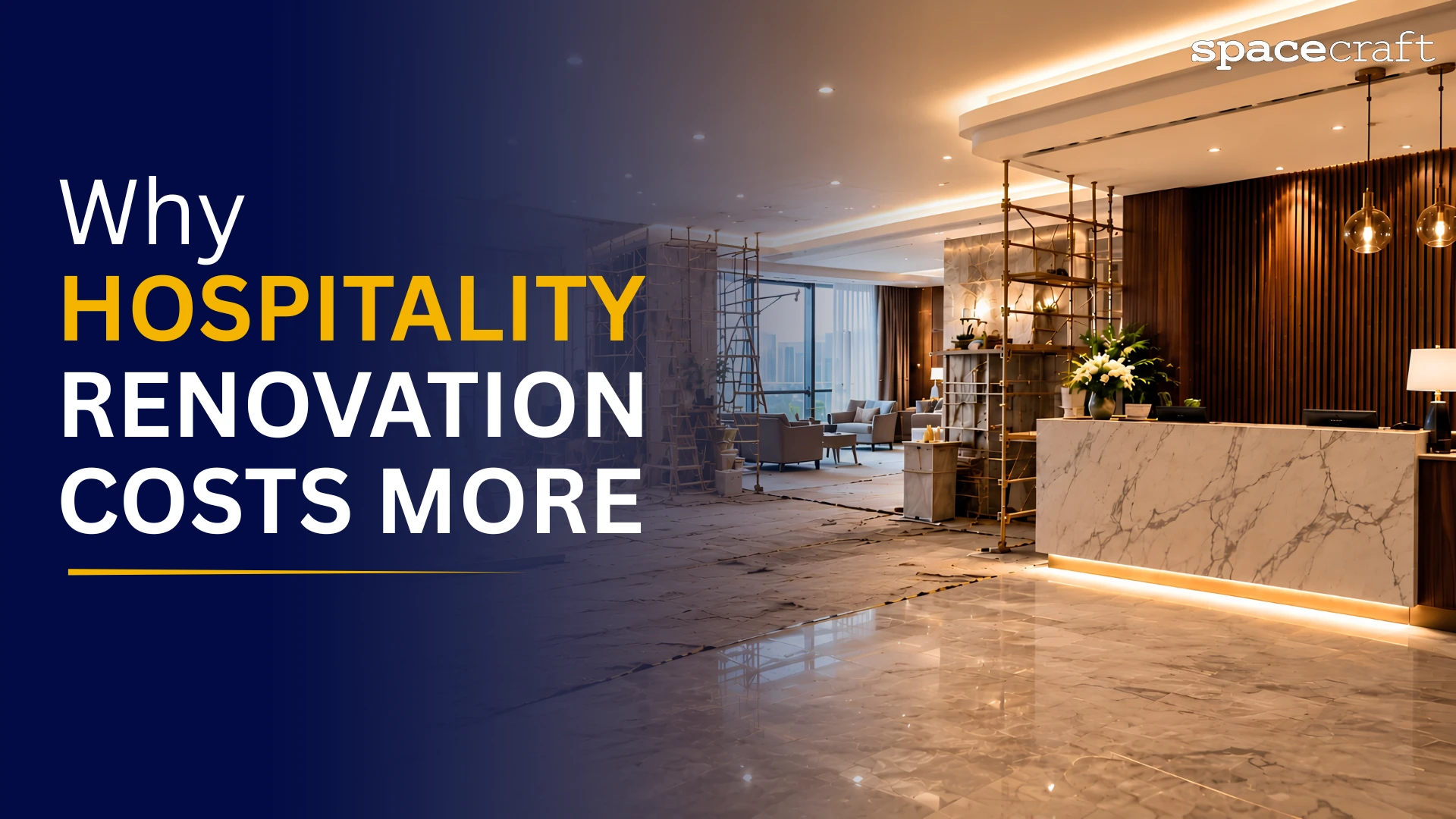
Why Hospitality Renovation Costs More
Restaurant, bar, café, and nightclub renovations usually cost more because the expensive work isn’t always the work customers notice. People see the bar top, the lighting, the seating, the tile. What they don’t see is the hood route sitting above the ceiling, or the grease interceptor buried under the kitchen floor, and that’s where a big chunk of the budget actually goes.
A few things drive that number up more than anything else:
- Commercial kitchen systems. Type I hoods, make-up air, grease duct routing, fire suppression, and grease interceptor sizing all add up fast, and equipment clearances alone can force a layout redo.
- Health department and fire review. A layout can look fine on the first draft and still come back with corrections, because prep areas, exits, or fire-safety requirements don’t line up the way the drawing assumed.
- MEP upgrades. Older spaces often don’t have the power, drainage, gas, or water capacity the new business actually needs, and finding that out mid-permit is expensive.
- ADA work in tight spaces. Restrooms, counters, seating, and paths of travel can force layout changes, particularly in older LA buildings where every square foot is already spoken for.
- Acoustic, structural, and life-safety work. Bars and nightclubs may need sound control, egress planning, and occupancy coordination well before the visible design work starts to matter.
None of that is a finish package. It’s a building problem, and by the time a customer walks into the finished room, a large share of the money already went into making the space legal, safe, and buildable in the first place.
Commercial Renovation vs. Tenant Improvement
The two get used interchangeably a lot, but they’re answering different questions. Renovation is about what the space physically needs done to it. Tenant improvement is about who’s paying for what, under what lease.
Category | Tenant Improvement | Commercial Renovation |
What it means | Lease-related build-out work | Construction work to update or rebuild a commercial space |
Applies to | Tenants in leased spaces | Leased or owned commercial spaces |
Landlord contribution | Often possible through a TI allowance | Not automatically included |
Main concern | Making the space fit the tenant’s use | Scope, permits, systems, sequencing, and cost |
Can overlap? | Yes | Yes |
What Drives the Cost Up in LA
People budget around what they can see, and that’s really where things go wrong. Flooring, lighting, paint, fixtures, all easy to price because they’re sitting right in front of you during the walkthrough. What’s harder to price is what’s behind the walls or above the ceiling, and older LA buildings tend to hide things there: an undersized electrical panel, a plumbing route that was never quite right, unpermitted work from two or three tenants back that nobody flagged.
Then there’s change of use, which catches people off guard more than almost anything else on this list. Turning retail into a restaurant isn’t cosmetic work. It touches ventilation, plumbing, electrical load, restrooms, storage, sometimes even zoning. Same thing happens when a basic commercial unit becomes a bar, nightclub, or café, the space can look open and flexible on the walkthrough, but it’s really the new use that decides what the building has to support, not the square footage.
Permits are their own animal, and honestly this is where a lot of budgets actually come apart. Spacecraft Group’s process, for example, folds in LADBS plan check coordination, LA County Health Department review, LAFD fire marshal clearance, ADA review, and correction responses as part of a standard hospitality approval path in LA. A single correction can turn into a drawing change, and a drawing change can turn into a construction change, and by the time that’s done it’s usually turned into a budget change too, all before the project even gets to the part a customer will see.
What to Look for Before You Budget
For hospitality work, don’t just ask whether a contractor has done commercial projects before. Ask whether they’ve actually dealt with the messy parts. Restaurants, bars, nightclubs, cafés, and boutique hotels fail in different places than a standard office job does.
Look at whether the team understands hospitality-specific approvals, commercial kitchen construction, hood and ventilation coordination, grease management, fire review, ADA constraints, and MEP budgeting. A clean drawing set only matters if it reflects what the building can actually handle. This is where an integrated design, permit, and build process earns its keep, and it’s the model Spacecraft Group builds around: architects and licensed general contractors serving hospitality and retail from concept drawings through certificate of occupancy, which suits projects where handoffs between separate teams tend to get expensive fast.
Final Take
Commercial renovation cost per square foot in Los Angeles is a starting point, not a final budget. Light office work stays near the lower end most of the time. Restaurants, bars, nightclubs, cafés, and boutique hotels climb higher, and they climb for a reason: more systems, more approvals, less room for assumptions that turn out wrong.
If you’re looking at a space in LA, price the real scope before you commit to the lease, the opening date, or the number you gave investors. The rent might look good. The location might feel right. But if the building can’t support the use without heavy ventilation, electrical, plumbing, fire, health, or accessibility work, the commercial renovation cost is going to tell you that pretty quickly, and it’s a lot cheaper to hear it before signing than after.
FAQ’s
How much does commercial renovation cost per square foot in Los Angeles?
Commercial renovation in Los Angeles can start around $50 per square foot for small works and go beyond $700 per square foot for complex restaurant, bar, nightclub, etc.. That range looks wide because it is wide, a small paint-and-flooring refresh is nowhere near the same job as rebuilding a space around kitchen equipment, ventilation, plumbing, fire review, accessibility, and agency approvals.
Why do restaurants and bars cost more to renovate?
Because the expensive work like Hood systems, grease routing, make-up air, plumbing, electrical upgrades, fire safety review, etc can all hit the budget before customers ever see the lighting, seating, bar top, or wall finish.
Is commercial renovation the same as tenant improvement?
Not exactly, commercial renovation is the broader construction work done to update, rebuild, or reconfigure a business space, while tenant improvement is usually lease-related work done for a tenant, sometimes with a landlord allowance. A leased restaurant build-out can be both at the same time, which is where the confusion usually starts.
Should I get a renovation estimate before signing a lease?
Yes, especially if the space is going to become a restaurant, bar, café, nightclub, or hospitality project. A pre-lease estimate can show whether the building can actually support the business, what systems may need upgrading, and whether the commercial renovation cost still makes sense before rent starts and the surprises become yours.
start your project
ready to build something extraordinary?
tell us about your restaurant, bar, nightclub or retail project. we respond within one business day at no cost and with no obligation.
no commitment required · response within 1 business day · serving all of southern california
design. permit. build.
1256 N Sycamore Ave, los angeles, california 90038
(323) 469-9029 hello@spacecraftgroup.com spacecraftgroup.comservices
© 2026 spacecraft group. licensed general contractor, california. all rights reserved. | designed by rudronix media